
State Credit Laws · Alabama
Alabama Credit & Debt Laws
Alabama gives collectors three or six years to sue, depending on the paperwork. A payment restarts the clock only if it is made before the time runs out. Here are the figures that matter — how long you can be sued, what is safe from garnishment, and what is protected — with the citation for each.
The clock: 3–6 years — Ala. Code §§6-2-34(9), 6-2-37(1). Checked on 5 November 2026.
Level 01 · Overview
The key points
Everything below this box is the same eight points with the evidence attached. If you only read one thing on this page, read this one.
- How long you can be sued — 3 to 6 years. Six years on a written contract, three on an open account — Ala. Code §§6-2-34(9), 6-2-37(1). The clock starts when you miss a payment and never catch up.
- Only a timely payment restarts it. A partial payment counts only if made before the time runs out. After that, only a signed, unconditional written promise to pay revives the debt — §6-2-16.
- No state ban on old-debt suits. Age is a defense you must raise in court. Federal Regulation F bars a debt collector from suing on a time-barred debt — 12 C.F.R. §1006.26(b).
- No state collection act. Alabama has no debt collection statute of its own. The federal FDCPA does the work, and it rarely covers a bank collecting its own debt.
- Your paycheck. For a consumer credit debt, a garnishment takes the lesser of 25% or pay above $217.50 a week (30 × the federal $7.25). On $1,000 take-home, the most is $250 — the same as federal law — §5-19-15.
- Your home. $18,800 of equity, up to 160 acres; $20,475 for claims from 1 April 2027. From 1 June 2026, owners 62 or older or disabled protect $56,400 — §§6-10-2, 6-10-12; Act 2026-203.
- Your bank account. Deposited wages may lose their wage protection. Claim the money under the $9,400 personal property exemption — §6-10-6. Two months of direct-deposited federal benefits are protected.
- What a violation is worth. Under the FDCPA, actual losses plus up to $1,000 per case and attorney’s fees — 15 U.S.C. §1692k. Alabama’s Deceptive Trade Practices Act may add more; whether it reaches debt collection is not settled.
Want all of that as one document you can print and work from? That is the next level, and it is also free.
How long you can be sued — 3 to 6 years
Alabama has two clocks for consumer debt. A written contract gets 6 years, under Ala. Code §6-2-34(9). An open account gets 3 years, under Ala. Code §6-2-37(1). Credit cards sit between the two. Courts have treated them both ways, often depending on whether the creditor can produce a signed agreement. This point is not settled in Alabama.
The harder question is from when. It runs from accrual — usually the first missed payment you never made up. Not from when the account was opened, and not from when a debt buyer bought it. If you opened the account in another state whose shorter limit already barred the claim, Alabama honors that bar — Ala. Code §6-2-17.
Timing decides what restarts it. A partial payment made before the time runs out starts the count again — Ala. Code §6-2-16. After the time has run, a payment does not revive the debt under the statute’s words. Only an unconditional written promise to pay, signed by you, does. A phone call saying “I owe it” does not count, and neither does a letter that admits the debt without promising to pay.
No state ban on suing on an old debt. No Alabama statute stops the suit. Age is a defense you must raise yourself. Federal Regulation F bars a debt collector from suing, or threatening to sue, on a time-barred debt — 12 C.F.R. §1006.26(b).
One thing to know before you do anything else. An expired debt is not erased. A collector may still ask you to pay, and the debt can stay on your credit report until the federal seven-year limit. If you are sued anyway, you must answer and raise the time limit. Most Alabama debt suits go to district or small claims court, where you have 14 days after service to file an answer. Circuit court gives 30 days.
The $3 Alabama deep dive takes it from here: how to establish your accrual date, what restarts the clock, and the letter that answers a collector without conceding anything.
What they can and cannot take
Your paycheck. A creditor needs a court judgment first. For a consumer credit debt, a garnishment may not take more than the lesser of 25% of weekly disposable earnings, or the amount above 30 times the federal minimum wage — Ala. Code §5-19-15. Alabama has no state minimum wage, so the federal $7.25 applies and the first $217.50 a week is protected. On $1,000 a week take-home, the most that can be taken is $250 — the same as federal law alone. Some court forms still print 20%; that figure is only for debts created before 12 April 1988. The statute controls, so check the figure on your own order.
But not once it is deposited. Wages are protected while they are wages. Money in your bank account may not keep that protection. Claim it under the personal property exemption — $9,400 of property of your choice, including money in the bank, rising to $10,225 for claims from 1 April 2027 — Ala. Code §§6-10-6, 6-10-12. Banks must leave two months of direct-deposited federal benefits alone. If an account is frozen, file a sworn claim of exemption with the clerk at once. The creditor has 10 days to contest it, and a contest gets a hearing within 7 days — Ala. R. Civ. P. 64B.
Your home. You can protect $18,800 of equity in the home you live in, up to 160 acres. That rises to $20,475 for claims from 1 April 2027 — Ala. Code §§6-10-2, 6-10-12. From 1 June 2026, owners 62 or older or disabled can protect $56,400 — Act 2026-203. Whether the 2027 update raises that figure too is not yet clear. Your own mortgage or home-equity loan, the IRS, a signed waiver of exemptions and equity above the cap can all still reach the home.
Everything else. Clothing, books and family portraits are protected on top of the $9,400 wildcard. Social Security, SSI and VA benefits are protected in full. Alabama lets a person waive exemptions in a signed writing — Ala. Code §6-10-120 — so check old loan papers for one.
The $3 Alabama deep dive has the exemption detail, which debts still reach a protected home, how to protect deposited wages, and what to do the day an account is frozen.
Doing this is the easy part. Keeping the paper trail is not. The bundle has the letters, the trackers and the deadlines already built.
Get all 4 volumes — only $47What Alabama law adds to federal law
Alabama has no debt collection statute of its own. The federal FDCPA does most of the work. It covers collection agencies and law firms that sue on consumer debts. It does not usually cover a bank collecting its own debt, and a debt buyer collecting only for itself may fall outside it too.
What that means for you. When the bank that issued your card calls, no Alabama collection law reaches it. Alabama sets no state duty to send documents on request. The federal dispute right does the work: dispute in writing within 30 days of the collector’s first notice, and it must stop collecting until it verifies the debt — 15 U.S.C. §1692g(b).
What a violation is worth. Under the FDCPA, your actual losses, plus up to $1,000 per case and attorney’s fees, within one year — 15 U.S.C. §1692k. Alabama’s Deceptive Trade Practices Act allows actual losses of at least $100, up to three times that at the court’s choice, and attorney’s fees — Ala. Code §8-19-10. You must send a written demand 15 days before suing, and you have one year from discovery, four at most — §8-19-14. Whether the DTPA reaches debt collection is not settled.
Licensing and complaints. Alabama charges collection agencies a license tax, but no state agency vets them — Ala. Code §40-12-80. Complaints go to the Alabama Attorney General’s Consumer Interest Division at alabamaag.gov, and to the CFPB. With no state act, the CFPB is often the strongest channel.
The $3 Alabama deep dive sets out what that means for your accounts, what a violation is worth, and the letter that puts the right party on notice.
Figures on this page were checked on 5 November 2026, and every citation is printed so you can verify it yourself. Legislatures change these provisions — if you are relying on a date calculation, check the current text.
Show your work
Where these numbers come from
Every figure above is somebody’s law, and laws move. So here is the source for each one, when it took effect, the day we last read it, and how sure we are. Where we are not sure, it says so.
Reported — read in the 2025 Code of Alabama on 4 November 2026. The official code site could not be read directly.
Reported — read in the 2025 Code of Alabama on 4 November 2026. Payment counts only before the bar; after it, only a signed written promise.
Derived — read on 4 November 2026. The $217.50 floor is our arithmetic: 30 × $7.25.
Verified — read in the Treasurer’s exemption table on 4 November 2026. $18,800 / $9,400 now; $20,475 / $10,225 from 1 April 2027.
Verified — read in the enrolled text on 4 November 2026. $56,400.
Verified — read on 4 November 2026. 14 days after service.
Reported — read in the 2025 Code of Alabama on 4 November 2026.
What we have changed here
- 5 November 2026. Page brought up to date with the $3 report. Corrected: a payment restarts the clock only if made before the time runs out, and after that only a signed written promise revives the debt — the earlier version said a payment or acknowledgment generally restarted it. The wage cap is now cited to §5-19-15. Added the $20,475 homestead from April 2027, the $56,400 homestead for owners 62 or older or disabled, the $9,400 wildcard, the 14-day answer deadline and the penalties.
- 1 June 2026. Act 2026-203 took effect: owners 62 or older or disabled can protect $56,400 of home equity.
The figures are free. The mechanics are $3.
This page tells you what the numbers are. The deep dive tells you how to use them on your debt, with the dates worked out and the letters written.
Everything above is yours for nothing, and it stays that way. But knowing the move and having the paperwork ready to send are two different days.
- How to establish your accrual date, step by step
- What restarts the clock in Alabama, and what it requires
- Which debts still reach a protected home
- What a collection-practices violation is worth
- The letters — ready to sign and post
- One-time $3. No subscription, nothing to cancel.
Level 03 · CreditDepth™ deep dive
What this page does not tell you
The guide above is complete, and it is free. What it does not do is take the mechanism underneath all the way down — and that is where the deep dive starts.
CreditDepth™ · $3 deep dive · Instant PDF
Alabama Debt Defense, Explained
16 pages, two ready-to-send letters, every figure cited — checked November 2026
The guide above is the what. This is the why. Pick the one thing costing you the most right now — the charge-off, the collection, the late payment you know is wrong — and get the deep dive on that single issue.
It is written to be checked. Every claim names its source, and where the honest answer is that nobody knows, it says so instead of guessing.
- $3 one payment
- PDF instant download
- Sourced claim by claim
What is inside
- The exact letters for your situation, ready to send
- The order to send them in, and why the order matters
- What the other side is legally required to do, and by when
- The evidence package that gets taken seriously
- What to do when the answer comes back “verified”
- The deadlines that start the moment you post it
- What to do if they miss one
- The myths that waste a stamp and tip them off
Why it costs three dollars. Not as a price — as a filter. Most readers need the plan, not the machinery, and burying four thousand words of mechanics inside a free guide makes the guide worse for them. Three dollars keeps it separate and pays for the sourcing. There is no subscription behind it and nothing else to buy afterwards.
Instant PDF download after checkout.
Ready now. Edition 1, November 2026: 16 pages, 11 chapters and two letters, matched point for point to this page.
Nothing here is required. The guide above is complete on its own, and the deep dive adds understanding rather than steps.
Every deep dive on the site: browse the CreditDepth™ library.

Educational credit deep-dives are provided by CreditDepth™. Billing by TheCreditRebuilder™.com.
Keep reading
Next in Debt and Collections
Alabama Credit & Debt Laws — the full summary
The law behind this page
- Ala. Code §§6-2-34(9), 6-2-37(1) — Six years on a written contract; three years on an open account.
- Ala. Code §6-2-16 — Only a payment before the bar, or a signed written promise, removes it.
- Ala. Code §6-2-17 — If another state’s shorter limit already barred the claim, Alabama honors it.
- Ala. Code §5-19-15 — Consumer credit garnishment: the lesser of 25% or pay above $217.50 a week.
- Ala. Code §§6-10-2, 6-10-6, 6-10-12 — Homestead $18,800 ($20,475 from April 2027); personal property $9,400 ($10,225).
- Act 2026-203 — Homestead of $56,400 for owners 62 or older or disabled, from 1 June 2026.
- Ala. Code §§8-19-10, 8-19-14 — Deceptive Trade Practices Act: at least $100, up to 3×, fees; one year to sue.
- 12 C.F.R. §1006.26(b) — A debt collector may not sue or threaten suit on a time-barred debt.
What this summary does not cover
This is the what and the when. It does not take the mechanism underneath all the way down. That is the Level 03 deep dive, and it is a separate $3 document. You do not need it to use the guide above.
Free to read, free to print, free to keep. No email, no account.
Frequently asked questions
The questions Alabamians ask about debt, wages and the homestead
Click any question to expand. If yours isn’t here, reach our team directly.
Six years on a written contract and three years on an open account — Ala. Code §§6-2-34(9) and 6-2-37(1). Credit cards can fall under either, often depending on whether a signed agreement exists. The clock runs from accrual — usually the first missed payment you never made up.
Only if you make it before the time runs out. Under Ala. Code §6-2-16, a partial payment in time restarts the count. After the bar is complete, only an unconditional written promise to pay, signed by you, revives the debt. Spoken words do not count.
Only after it wins a court judgment. For a consumer credit debt, it can take the lesser of 25% of weekly disposable pay or the amount above $217.50 — Ala. Code §5-19-15. On $1,000 take-home, the most is $250.
Not automatically. Deposited wages may lose their wage protection. Claim the money under the $9,400 personal property exemption, $10,225 for claims from 1 April 2027. Two months of direct-deposited federal benefits are protected. If an account is frozen, file a sworn claim of exemption with the clerk at once.
$18,800 for the home you live in, up to 160 acres, and $20,475 for claims from 1 April 2027. From 1 June 2026, owners 62 or older or disabled can protect $56,400 — Act 2026-203. Your own mortgage, the IRS and a signed waiver can still reach the home.
No. Alabama has no debt collection act of its own, and the federal FDCPA generally does not cover a bank collecting its own debt. Whether the Deceptive Trade Practices Act reaches debt collection is not settled.
No Alabama statute stops the suit. Age is a defense you must raise. Federal Regulation F bars a debt collector from suing or threatening to sue on a time-barred debt — 12 C.F.R. §1006.26(b). If it sues anyway, answer and raise the time limit; the court will not raise it for you.
Do not ignore it. In district or small claims court you have 14 days after service to file an answer. Circuit court gives 30 days. List the statute of limitations as a defense. A default judgment can follow even when you have a strong defense.
The mechanics this page leaves out: your accrual date step by step, two letters ready to sign and post, the order to send them, what the other side must do and by when, the evidence package, what to do when a dispute comes back “verified” or a deadline is missed, and the myths that waste a stamp.
No. It is general education about Alabama and federal law, checked on 5 November 2026. For advice on your situation, speak to an Alabama attorney or a legal aid office.
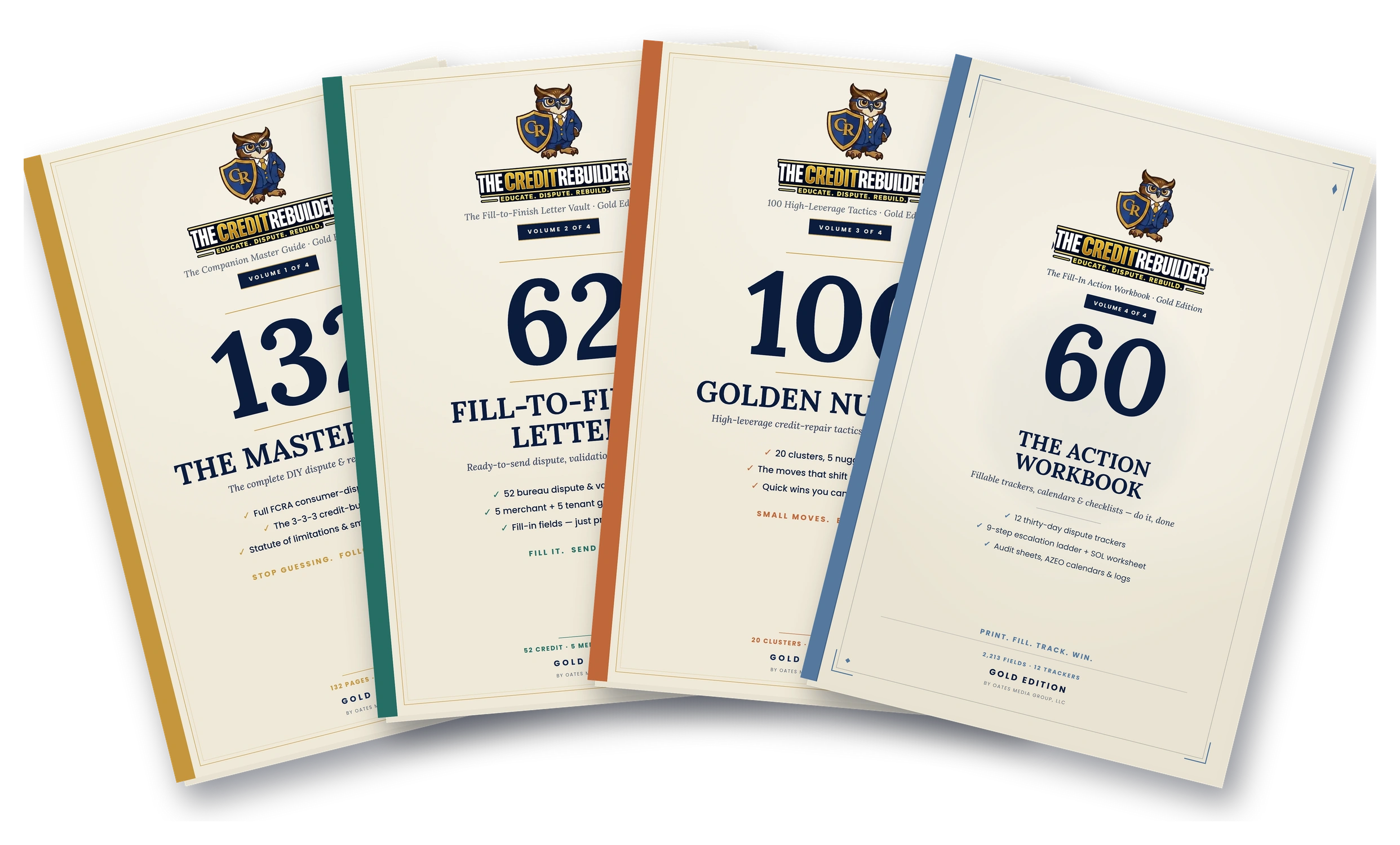
Get All 4 Volumes — Instant Access
One order. One download. The complete DIY credit-rebuilding system — education, letters, tactics, and the Action Workbook that ties it together.


- Full FCRA consumer-dispute framework
- The 3-3-3 credit-builder system
- Statute of limitations & settlement
- Small-claims court strategy

- Initial dispute & furnisher letters
- Method of Verification (MOV) requests
- FDCPA debt-validation letters
- §605B identity-theft block letters

- Bureau, furnisher & collector tactics
- Score-mechanic & utilization plays
- Mortgage-ready & medical-debt rules
- 7-year clock & derogatory-aging tactics

- Twelve 30-day dispute trackers
- 9-step escalation ladder + SOL table
- Active Disputes Roster & 12-month plan
- Reinsertion Watch Log — §1681i(a)(5)(B)
By checking the box below and clicking "Get Instant Access," you (the "Purchaser") acknowledge and agree to each of the following:
- 1EDUCATIONAL PURPOSE ONLY. TheCreditRebuilder™ Gold Edition (the "Product") is an educational and informational resource. Nothing in it constitutes legal advice, financial advice, credit counseling, or credit-repair services as defined under the Credit Repair Organizations Act (CROA), 15 U.S.C. §1679 et seq., the Fair Credit Reporting Act (FCRA), 15 U.S.C. §1681 et seq., or any applicable state law.
- 2NO GUARANTEE OF RESULTS. Individual outcomes vary based on your credit profile, the specific inaccuracies in your report, your execution, and factors outside our control. No specific score improvement, approval, or credit outcome is guaranteed, promised, or implied. Any figures shown are illustrative examples, not predictions.
- 3INDEPENDENT CONSUMER ACTION. You are exercising legal rights you already possess as a consumer. Oates Media Group, LLC is not a credit-repair organization under CROA §1679a(3) and does not act as your agent, attorney, or representative in any dispute.
- 4IMMEDIATE DIGITAL DELIVERY. The Product is delivered electronically right after purchase, and you consent to that immediate delivery. If you have not downloaded, opened or otherwise accessed any file in your Order, you may request a full refund; once a file has been accessed, the Order is final. Nothing here takes away a right you have under the law of your state or country that cannot be given up by agreement.
- 5AGE, CAPACITY, AND AUTHORITY. You represent that you are at least 18 years of age, have full legal capacity to enter this agreement, and are not purchasing on behalf of a credit-repair organization.
- 6GOVERNING LAW. This agreement is governed by the laws of the State of Delaware, and any dispute shall be resolved by binding individual (non-class) arbitration administered by the American Arbitration Association under its Consumer Arbitration Rules, with hearings held online, as set out in Section 14 of our Terms of Sale. You may opt out within 30 days of your first order.
Educational credit deep-dives are provided by CreditDepth™. Billing by TheCreditRebuilder™.com


